Addiction & Substance Use Disorder
Understanding Addiction
Addiction, also known as substance use disorder, is not a failure of character or a lack of willpower. Rather, it is a chronic medical condition that alters the structure and function of the brain in measurable, well-documented ways. With the right medical treatment, it can be stabilized and managed like other chronic health conditions.
This page provides a thorough, evidence-based overview of how addiction develops, what it does to the brain, and what effective treatment can accomplish. Patients and families will find plain-language explanations of complex concepts.
Clinicians will also find this a useful reference for understanding the condition or referring a patient for outpatient addiction care.
If you or someone you love is affected by addiction or substance use disorder, help is available. Call or connect with us today.
What is Addiction & Substance Use Disorder?
Also known as addiction, substance use disorder begins with repeated, unhealthy use of alcohol or drugs. Over time, this pattern alters brain chemistry and erodes a person’s capacity for behavioral control. Eventually, the brain sends powerful, persistent signals to continue using, even when doing so causes serious harm.
The American Society of Addiction Medicine defines substance use disorder as a chronic, treatable medical condition. Specifically, it arises from complex interactions among brain circuits, genetics, environment, and personal life experience. Therefore, addiction is a medical problem, not a behavioral or moral one.
While the brain changes that drive addiction are significant, they are not necessarily permanent. Research shows meaningful structural and functional recovery with sustained abstinence and appropriate treatment. This capacity for change is the foundation on which effective treatment is built.
How Addiction Develops in the Brain
The Brain’s Reward System
To understand addiction, it helps to understand how the brain normally handles reward. A healthy brain reinforces natural rewards such as eating, sleeping, and social connection, by activating circuits that produce pleasure and satisfaction. Those feelings motivate repetition of the behavior. This is an adaptive and protective design that supports survival and well-being.
How Substances Alter the Reward System
Addictive substances exploit this process directly. Specifically, alcohol, opioids, stimulants, and other drugs trigger dopamine release at levels far exceeding what any natural experience produces. As a result, the brain registers this as an extraordinary reward and encodes it as something worth pursuing again.
With continued use, the brain adapts by reducing its own dopamine production and lowering receptor sensitivity. Consequently, ordinary pleasures lose their appeal, and larger amounts of the substance are needed to produce the same effect.
From Pleasure to Compulsion
At the same time, the brain’s threat and distress systems become sensitized. Without the substance, a person begins to feel anxious, restless, and emotionally dysregulated. As a result, continued use is no longer primarily about producing pleasure. Instead, it becomes a way to avoid the distress of not using. This shift marks a significant turning point in the addiction cycle.
Moreover, repeated substance use progressively damages the prefrontal cortex, which is the region responsible for planning, judgment, and impulse control. This is also the region that should help a person recognize harm and act on a decision to stop. When that region is impaired, even genuinely motivated individuals find it extremely difficult to follow through. Therefore, willpower alone is rarely sufficient, and addiction requires medical treatment.
Brain Regions in the Addiction Cycle
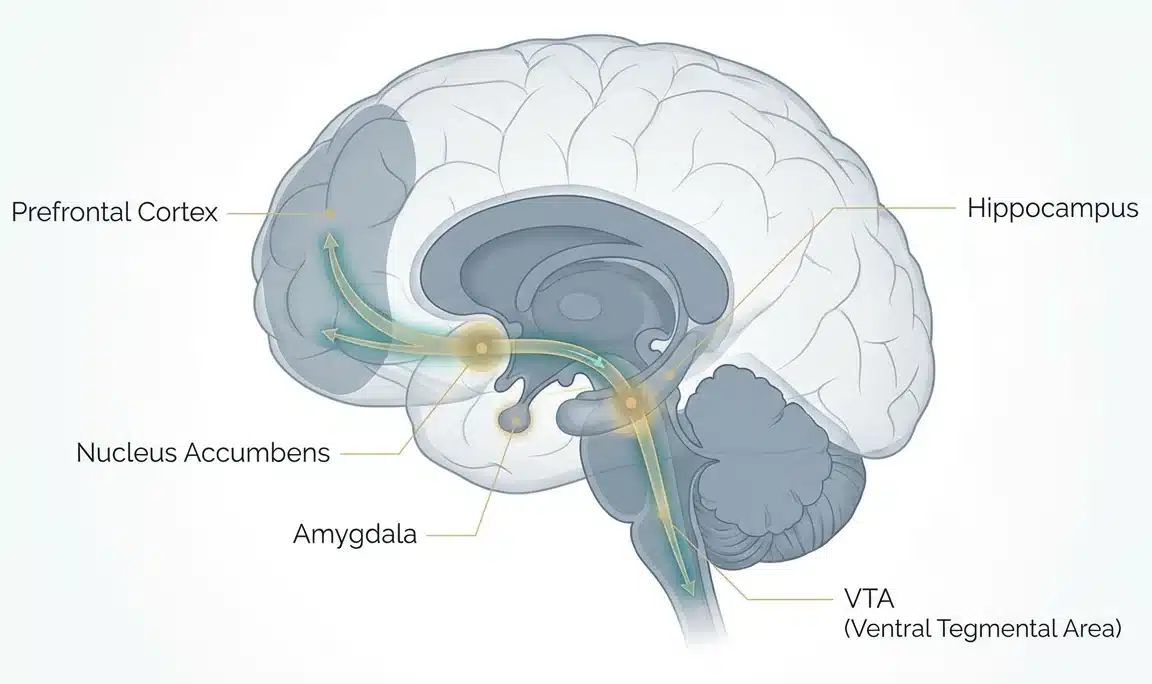
Five brain regions and key neural circuits play interconnected roles in how addiction develops and persists. Understanding each one helps explain why the condition behaves the way it does.
Ventral Tegmental Area
The ventral tegmental area, commonly called the VTA, is the brain’s primary dopamine, “feel-good” chemical source for reward circuitry. When a person uses an addictive substance, the VTA releases dopamine in large quantities. As a result, this generates intense pleasure that reinforces continued use and creates powerful memories of the experience.
Nucleus Accumbens
The nucleus accumbens is the brain’s central reward hub. Specifically, it receives dopamine from the VTA and produces the euphoria associated with drug use. With repeated exposure, it becomes hypersensitive to substance-related cues. Even so, a passing environmental reminder, such as a familiar location or smell, can trigger an intense craving well before any substance is present.
Prefrontal Cortex
The prefrontal cortex governs decision-making, impulse control, and the evaluation of consequences. However, chronic substance use impairs this region progressively. Consequently, the ability to resist urges, weigh risks accurately, and follow through on a decision to stop becomes significantly reduced over time.
Amygdala
The amygdala processes emotional responses and forms strong associations between experiences and the stimuli surrounding them. Specifically, it links the effects of substances to particular people, places, and situations. During withdrawal and periods of abstinence, it therefore generates anxiety and emotional distress that create persistent pressure to resume use.
Hippocampus
The hippocampus forms and retrieves memory, particularly memories tied to context. It records the circumstances in which drug use occurred. Because of this, context-dependent memories can resurface powerfully when a person returns to familiar environments and are a well-established driver of relapse.
Who Is at Higher Risk of Addiction?
Addiction does not develop the same way in every person.
Genetics and Environment
Genetics contribute meaningfully to individual vulnerability. Research consistently shows that substance use disorders run in families, and specific gene variants are associated with increased risk for particular substances. However, no single gene determines outcomes. Genetic susceptibility raises risk but does not make addiction inevitable.
Environmental factors are equally important. Adverse childhood experiences, including abuse, neglect, and early exposure to household substance use, substantially increase lifetime risk. Similarly, chronic stress, social isolation, and limited access to stable housing and supportive relationships raise vulnerability across all age groups.
Age and Co-Occurring Conditions
The age at which a person first uses substances is among the strongest predictors of later disorder. Adolescents carry particular risk because the prefrontal cortex, which governs impulse control and risk assessment, does not fully mature until the mid-twenties. Additionally, reward circuits in the adolescent brain are more reactive, making substance use more reinforcing and its consequences harder to anticipate.
Co-occurring mental health conditions further elevate risk. Anxiety disorders, depression, PTSD, bipolar disorder, and ADHD are all significantly more common in people with substance use disorders. Therefore, treating both conditions together consistently leads to better outcomes than addressing either one on their own.
Signs of Substance Use Disorder
Substance use disorder exists on a spectrum from mild to severe. The Diagnostic and Statistical Manual of Mental Disorders, Fifth Edition, Text Revision (DSM-5-TR) defines it by the presence of two or more diagnostic criteria within a twelve-month period.
These include using more than intended, unsuccessful efforts to cut back, spending substantial time around substance use, failing to meet major responsibilities, continuing to use despite relationship or health problems, withdrawing from valued activities, using in physically hazardous situations, and experiencing cravings, tolerance, and withdrawal.
Severity is classified as mild when two or three criteria are present, moderate with four or five, and severe with six or more. Importantly, a diagnosis at any severity level indicates a medical condition that benefits from professional evaluation. Also, earlier identification and earlier intervention both lead to meaningfully better outcomes.
Substance Use Self-Assessment
If you are unsure whether your use has become a problem, the self-assessment is a good place to start.
Types of Addiction
Different substances affect the brain through distinct mechanisms. Each, therefore, produces its own pattern of intoxication, withdrawal, and long-term health risk. Understanding these differences is important for matching each person to the most appropriate treatment approach.
The following links lead to detailed pages covering signs of disorder, health risks, and treatment for each substance.
Depressants and Opioids
Alcohol Use Disorder | Prescription Opioid Addiction | Heroin Addiction | Kratom Addiction | Tianeptine Addiction | Naloxone and Opioid Overdose Prevention
Stimulants
Cocaine Addiction | Methamphetamine Addiction | Synthetic Cathinones (Bath Salts) Addiction
Other Substances
Tobacco Addiction | Vaping and Nicotine Addiction | Cannabis Use Disorder | Benzodiazepine Use Disorder | Xylazine Exposure and Addiction | Polysubstance Use
Outpatient Addiction Treatment in Sarasota
Solstice Health & Wellness provides outpatient addiction treatment in Sarasota, Florida, through an integrated care model that combines addiction medicine, primary care, mental health services, and lifestyle support.
Addiction treatment works best when care is integrated, evidence-based, and patient-centered. We work to remove barriers to treatment. Our goal is to provide an inclusive and welcoming environment for every patient and family.
Effective treatment focuses on three core goals. First, it reduces harmful cravings and substance use. Second, it restores normal physical functioning. Third, it improves overall quality of life. Treatment may include medications, counseling, and coordinated medical care tailored to each individual.
Patients are welcomed at any stage of readiness, including those who are not yet ready to stop using completely. Harm reduction services, medication management, behavioral support, and coordinated medical care are all available within a single outpatient setting. Telehealth services extend access to patients across all of Florida.
Clinicians are welcome to refer patients directly. The practice accepts referrals for outpatient evaluation and treatment across the full spectrum of substance use disorder severity, including cases with co-occurring mental health and medical conditions.
When to Seek Help
Substance use disorder is treatable at every stage. Earlier evaluation leads to better outcomes, but there is no point at which treatment stops being beneficial.
If you are concerned about your own substance use or that of someone in your life, a clinical evaluation is the most important first step. You do not need to be in crisis to reach out.
Frequently Asked Questions
1. Is addiction a disease or a choice?
Addiction is a chronic medical condition, not a choice. Specifically, it produces measurable changes in the brain regions that control reward, emotion, and decision-making. Because of these changes, compulsive use continues even when a person genuinely wants to stop.
2. What is the difference between tolerance, dependence, and addiction?
Tolerance means the body needs more of a substance to produce the same effect. Dependence, by contrast, means withdrawal occurs when use stops. Addiction involves compulsive use and loss of control despite serious consequences, and it may occur with or without physical dependence.
3. Can the brain recover from long-term substance use?
Yes. Even after prolonged use, the brain retains a meaningful capacity for recovery. With sustained abstinence and appropriate treatment, the regions governing reward, impulse control, and emotional regulation can, over time, regain significant function.
4. Why is it so hard to stop using without professional help?
Chronic substance use impairs the brain region responsible for impulse control while simultaneously sensitizing craving and distress circuits. As a result, unassisted cessation is extremely difficult even for highly motivated individuals. Fortunately, medications and behavioral treatment directly address these biological mechanisms.
5. Does addiction run in families?
Yes. Genetics contribute meaningfully to addiction risk, and substance use disorders are more common among biological relatives of affected individuals. However, genetic risk interacts with environmental factors, so having a family history does not make addiction inevitable.
6. What is a co-occurring disorder?
A co-occurring disorder is a mental health condition present alongside a substance use disorder. Common examples include anxiety, depression, PTSD, and ADHD. Because these conditions directly influence each other, treating both together leads to significantly better outcomes than addressing either one alone.
7. How is substance use disorder diagnosed?
Substance use disorder is diagnosed using DSM-5-TR criteria, which include loss of control, failed attempts to stop, and continued use despite consequences. Two or more criteria within twelve months indicate a diagnosable condition. Therefore, a clinical evaluation is always the necessary first step.
8. Does addiction severity matter for treatment?
Yes. Mild, moderate, and severe disorder each call for different levels of care and treatment intensity. Furthermore, earlier identification at a mild stage often prevents progression to more severe disorder. A clinical evaluation determines the most appropriate starting point.
9. Can adolescents develop addiction?
Yes, and they are especially vulnerable. Because the prefrontal cortex does not fully mature until the mid-twenties, impulse control and risk assessment are still developing during adolescence. As a result, the earlier substance use begins, the higher the lifetime risk of disorder.
10. What does it mean that addiction is a chronic condition?
Chronic means addiction follows a long-term course, similar to hypertension or diabetes. Consequently, resumed use after a period of stability indicates the treatment plan needs adjustment rather than that treatment has failed. In fact, long-term medical management consistently produces the best outcomes.
Medically Reviewed By
Frank Melo, MD
Board Certified Addiction Medicine and Family Medicine
Medical Director, Solstice Health & Wellness
Last Updated: May 2026
References
- Volkow ND, Koob GF, McLellan AT. Neurobiologic Advances from the Brain Disease Model of Addiction. New England Journal of Medicine. 2016.
- Koob GF, Volkow ND. Neurobiology of Addiction: A Neurocircuitry Analysis. Lancet Psychiatry. 2016.
- Parvaz MA, Rabin RA, Adams F, Goldstein RZ. Structural and Functional Brain Recovery in Individuals With Substance Use Disorders During Abstinence: A Review of Longitudinal Neuroimaging Studies. Drug and Alcohol Dependence. 2022.
- Koob GF, White PH. The Brain in Addiction and Recovery. National Institute on Alcohol Abuse and Alcoholism. 2025.
- Camí J, Farré M. Drug Addiction. New England Journal of Medicine. 2003.
- Deak JD, Johnson EC. Genetics of Substance Use Disorders: A Review. Psychological Medicine. 2021.
- Zhu J, Racine N, Devereux C, Hodgins DC, Madigan S. Associations Between Adverse Childhood Experiences and Substance Use: A Meta-Analysis. Child Abuse & Neglect. 2023.
- American Psychiatric Association. Diagnostic and Statistical Manual of Mental Disorders, Fifth Edition, Text Revision (DSM-5-TR). American Psychiatric Publishing; 2022.
- Hunt GE, Siegfried N, Morley K, Brooke-Sumner C, Cleary M. Psychosocial Interventions for People With Both Severe Mental Illness and Substance Misuse. Cochrane Database of Systematic Reviews. 2019.
- Simpson EL, Essat M, Wong R, Stacey S, Day E. Effectiveness of Psychosocial Interventions for Adults With Substance Use Disorder That Have a Co-Occurring Common Mental Health Disorder: An Umbrella Review. Drug and Alcohol Review. 2025.
- McPheeters M, O’Connor EA, Riley S, et al. Pharmacotherapy for Alcohol Use Disorder: A Systematic Review and Meta-Analysis. JAMA. 2023.
- Department of Veterans Affairs/Department of Defense. VA/DoD Clinical Practice Guideline for the Management of Substance Use Disorders. 2021.
Medical Disclaimer: The information provided on this page is for educational purposes only and is not a substitute for professional medical advice, diagnosis, or treatment. Always seek the advice of a qualified healthcare provider with any questions you may have regarding a medical condition.