
Brixadi Treatment for Opioid Use Disorder

Understanding Brixadi Treatment
Brixadi is an FDA-approved buprenorphine injection that treats moderate to severe opioid use disorder in adults. Unlike other injectable options, Brixadi comes in both weekly and monthly forms. As a result, patients and providers have more choices when picking the right dosing schedule. Instead of taking a daily film or tablet, you simply receive an injection at the office on a schedule that fits your needs.
Opioid use disorder affected about 3.7 percent of U.S. adults, roughly 9.4 million people, in 2022. In addition, it caused more than 53,000 deaths in 2024. Even though strong evidence shows that medications for opioid use disorder greatly cut the risk of overdose and death, only about 25 percent of people with OUD currently receive these medications.
At Solstice Health & Wellness in Sarasota, Florida, Brixadi is offered within an integrated addiction treatment program that coordinates substance use care, mental health, primary care, and lifestyle wellness services into a comprehensive plan.
What is Brixadi?
Brixadi (buprenorphine extended-release injection) has FDA approval for the treatment of moderate to severe opioid use disorder in adults. It is a Schedule III controlled substance. Notably, Brixadi contains buprenorphine only and not naloxone.
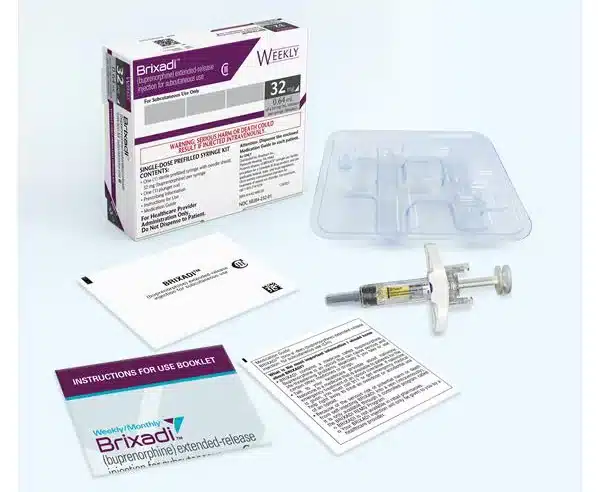
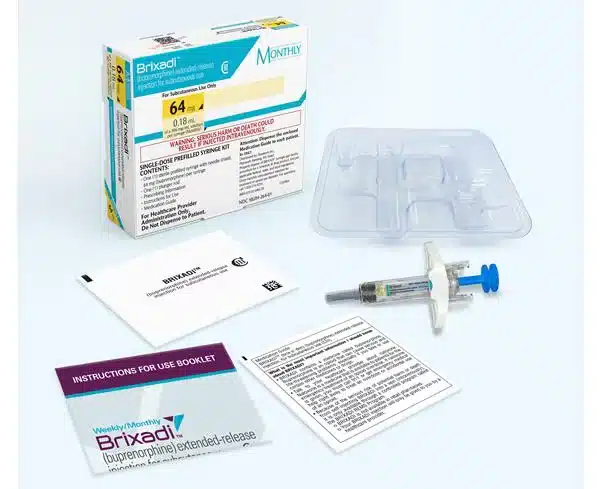
Brixadi comes in two forms:
- Brixadi Weekly: Available in 8 mg, 16 mg, 24 mg, and 32 mg doses
- Brixadi Monthly: Available in 64 mg, 96 mg, and 128 mg doses
Buprenorphine is a partial opioid agonist. In simple terms, it turns on the same brain receptors as opioids, but with a built-in ceiling effect. Because of that ceiling, it limits the high and the breathing problems that full opioid agonists cause. As a result, buprenorphine cuts cravings and withdrawal symptoms while carrying a lower risk of misuse.
Learn more about how buprenorphine works →
How Does Brixadi Work?
After the injection, Brixadi changes from a liquid into a gel-like deposit beneath the skin. This deposit then slowly releases buprenorphine at a steady rate as it breaks down — either over one week or one month, depending on the form. Because of this slow release, Brixadi removes the need for daily medication. It also avoids the ups and downs that daily forms often produce.
More specifically, Brixadi provides three key effects:
- Steady activation of opioid receptors at a level that cuts cravings and prevents withdrawal
- A ceiling effect that limits the high and breathing risks tied to full opioid agonists like fentanyl or heroin
- Opioid blockade that reduces the rewarding effects of illicit opioid use
How Quickly Does Brixadi Reach Full Effect?
After the injection, buprenorphine levels peak at about 24 hours for the weekly form and 6 to 10 hours for the monthly form. After that, steady-state levels build up over the first four weekly or monthly doses. During this time, your provider may adjust your dose to find the right level.
Myth: “You have to come to the office every week forever.”
Fact: In reality, weekly injections are usually just a starting point. Once you are stable, most patients move to monthly injections, meaning just one office visit per month for your injection.
Who is a Good Candidate for Brixadi?
Brixadi may be right for people who:
- Want the choice between weekly and monthly injections
- Are currently stable on under-the-tongue buprenorphine and want to switch to an injectable
- Are starting buprenorphine treatment for the first time (Brixadi weekly can begin after a single test dose of under-the-tongue buprenorphine)
- Have trouble remembering to take daily medication
- Want steady medication levels without the ups and downs of daily dosing
- Are worried about medication safety or sharing
- Are pregnant or planning pregnancy, because the Brixadi weekly form does not contain NMP, a solvent that has shown harmful effects on fetal growth in animal studies
On top of that, Brixadi’s weekly option allows providers to watch patients more closely during the early weeks of treatment. This can be especially helpful for patients using fentanyl or those with complex medical needs.
Who Should Not Take Brixadi?
Certain people should avoid Brixadi. These include people with severe liver disease, people with a known allergy to buprenorphine or any of the injection ingredients, and people currently high on opioids, because starting too soon can trigger sudden, severe withdrawal.
In addition, the Brixadi syringe packaging contains natural rubber latex. Therefore, people with latex allergies should talk to their provider about this before starting.
Not yet on buprenorphine? Learn about sublingual buprenorphine to get started →
Prefer a monthly-only injection? Learn about Sublocade →
How Effective is Brixadi (Buprenorphine)?
Brixadi works just as well as daily sublingual (under-the-tongue) buprenorphine-naloxone, also known as SL buprenorphine. In fact, the main clinical trial showed that Brixadi patients had a slightly higher response rate, 16.9 percent compared with 14.0 percent in the daily group.
What Do the Studies Show?
When researchers looked more closely at drug-free test results over six months, Brixadi actually showed better results than daily SL buprenorphine. More than half (56.8 percent) of Brixadi patients had at least some opioid-free test results, compared with 40.5 percent in the daily group. On top of that, nearly twice as many Brixadi patients tested fully opioid-free throughout the study (10.8 percent vs. 6.5 percent).
A separate trial confirmed these findings. In that study, weekly and monthly buprenorphine injections were comparable to daily SL buprenorphine on both main measures. However, when researchers dug deeper into the data, the injections actually showed better results, especially during the monthly phase.
How Do Patients Feel About the Injection?
Patients also prefer the injectable form. In another clinical trial, patients on buprenorphine injections reported higher satisfaction with their treatment. They also found it easier to use and felt less burdened by their medication routine. Importantly, these benefits came without any increase in side effects.
Do Patients Stay in Treatment?
Yes. About 69 percent of Brixadi patients finished the full six-month study. This was very close to the 72.6 percent completion rate in the daily group. In other words, patients on Brixadi stayed in treatment just as long as those taking daily medication, while gaining the added benefits of less frequent dosing.
How Does Brixadi Compare With Other Treatments?
Several FDA-approved medications treat opioid use disorder. The right choice depends on each person’s needs, treatment history, and clinical goals. For this reason, providers and patients should make this decision together.
Brixadi vs. Suboxone (Sublingual Buprenorphine)
Both contain buprenorphine, but patients take them in different ways. Suboxone dissolves under the tongue daily at home. Brixadi, on the other hand, is an injection that a provider gives in the clinic, either weekly or monthly. As a result, the injection removes daily dosing, which helps patients stay on track.
Brixadi also cuts the risk of missed doses, sharing, and accidental exposure in children. However, SL buprenorphine offers same-day start and easier dose changes.
Brixadi vs. Sublocade
Both are long-acting buprenorphine injections. However, Brixadi offers more choices because it comes in both weekly and monthly forms with more dose options (four weekly doses and three monthly doses). In contrast, Sublocade comes only as a monthly injection in two doses (300 mg and 100 mg).
Key differences include:
- Dosing choices: Brixadi offers seven dose options across two schedules. Meanwhile, Sublocade offers two doses on one schedule.
- Weekly option: Only Brixadi provides a weekly injection, which allows closer monitoring during early treatment.
- NMP content: The Brixadi weekly form does not contain N-methyl-2-pyrrolidone (NMP). However, the Brixadi monthly form does contain NMP, similar to Sublocade. This matters for pregnant patients, because NMP has shown harmful effects on fetal growth in animal studies.
- Switching between forms: Patients can move between Brixadi weekly and monthly based on clinical needs.
Brixadi vs. Vivitrol
These medications work in completely different ways. Brixadi partly activates opioid receptors at a controlled level. Vivitrol, by contrast, fully blocks opioid receptors. Key differences include:
- Vivitrol requires full opioid detox of 7 to 10 days before starting, which creates a major barrier. In the X: BOT trial, only 72 percent of patients assigned to Vivitrol were able to start treatment, compared with 94 percent for buprenorphine-naloxone.
- Once both medications are started, outcomes for preventing relapse are similar.
- Buprenorphine cuts the risk of death from all causes by about 60 percent. In contrast, naltrexone’s effect on death rates is less clear.
Benefits of Brixadi Treatment
Dosing Choices: Brixadi is the only injectable buprenorphine available in both weekly and monthly forms. Because of this, providers can tailor the dosing schedule to each patient’s needs, starting with weekly injections for closer monitoring and then moving to the monthly injectable when stable.
More Dose Options: With four weekly doses (8, 16, 24, 32 mg) and three monthly doses (64, 96, 128 mg), Brixadi allows more precise dose matching than other injectable options.
Stable Buprenorphine Levels: Like other injectable formulations, Brixadi provides steady buprenorphine release with smaller changes in blood level than the daily form. As a result, patients feel more consistent symptom control.
Lower Risk of Misuse and Sharing: Health care providers give Brixadi only in clinical settings. Because Brixadi forms a solid depot under the skin, it cannot be shared or misused the way take-home medications can.
NMP-Free Weekly Option: The Brixadi weekly form does not contain NMP. This may matter for pregnant patients or those with concerns about this solvent.
Myth: “Injectable buprenorphine is only for people who have failed daily medication.”
Fact: Actually, injectable buprenorphine is a treatment option, not a last resort. Many patients choose it from the start because they prefer the ease, steady levels, and reduced daily burden. Others switch to it after doing well on under-the-tongue buprenorphine.
Risks and Side Effects of Brixadi
Common side effects (affecting 5 percent or more of patients in clinical trials) include injection-site pain (9.9%), headache (7.5%), constipation (7.5%), nausea (7.0%), injection-site redness (6.6%), injection-site itching (6.1%), insomnia (5.6%), and urinary tract infection (5.2%).
Serious Warnings
The following serious warnings apply:
- Breathing problems: Life-threatening slowed breathing and death have occurred. The risk goes up when patients combine Brixadi with benzodiazepines, alcohol, or other sedating drugs.
- Newborn withdrawal: Babies born to mothers who took buprenorphine during pregnancy may have withdrawal symptoms after birth. This is expected and treatable.
- Adrenal problems: Cases have occurred with opioid use, more often after more than one month of use.
- Liver effects: Providers should check liver function tests before and during treatment, because hepatitis and liver events can occur.
- Sudden withdrawal: Starting Brixadi before withdrawal symptoms appear can trigger sudden, severe withdrawal. For this reason, a test dose with sublingual buprenorphine is often done first.
- Latex allergy: The syringe packaging contains natural rubber latex.
- Severe allergic reactions: Anaphylaxis has been reported in rare cases.
Post-Marketing Reports
Since Brixadi reached the market, reports have also noted injection-site abscesses, open sores, and tissue death, some needing wound care and antibiotics. These serious reactions are more likely if the injection goes into the muscle or skin rather than under the skin.
How to Manage Side Effects
Most side effects get better within the first few weeks of treatment. Here are some helpful tips:
Injection-Site Care
Apply an ice pack for comfort after the injection. Do not rub, press, or massage the injection site. Also, rotating injection sites between doses helps reduce reactions over time.
Other Common Side Effects
- Constipation: Use stool softeners, eat fiber, and drink plenty of water.
- Nausea: This usually gets better over time. In the meantime, eating small, frequent meals may help.
- Headache: Over-the-counter pain relievers can help. In most cases, this goes away within the first few weeks.
- Insomnia: Practice good sleep habits. If sleep problems continue, talk to your provider about options.
When to Contact the Office
Call your provider right away if you have trouble breathing, feel very drowsy, notice yellowing of skin or eyes, see signs of infection at the injection site (such as growing redness, warmth, swelling, or drainage), or have any unusual symptoms.
Myth: “The injection-site reactions are severe and common.”
Fact: While injection-site reactions do happen, they are mostly mild pain, redness, and itching that go away on their own. Serious reactions are rare and are more likely if the injection goes into the wrong layer of tissue.
Precautions and Safety
Patients should tell their provider about all medications they take, because drug interactions can occur. The following precautions apply:
- Benzodiazepines, alcohol, and other sedatives: Avoid these while on Brixadi because combining them raises the risk of life-threatening breathing problems.
- Liver disease: Brixadi is not recommended for patients with moderate-to-severe liver disease. Providers should check liver function tests before and during treatment.
- Pregnancy and breastfeeding: Talk to your provider first. The Brixadi monthly form contains NMP, which has shown harmful effects on fetal growth in animal studies. However, the Brixadi weekly form does not. Also, buprenorphine passes into breast milk.
- Latex allergy: The syringe packaging contains natural rubber latex. If you have a latex allergy, discuss other options with your provider.
- Surgery and emergency care: Tell your surgeon and emergency room staff that you are on Brixadi, because it affects how opioid pain medications work.
- Serotonin syndrome: Rare cases have occurred when providers combine buprenorphine with serotonin-boosting medications such as certain antidepressants.
- Naloxone access: All patients should keep naloxone (Narcan) on hand for overdose reversal.
- Fertility: Long-term opioid use may lower fertility. It is not yet known whether these effects can be reversed.
How is Brixadi Dosed and Given?
For Patients Not Currently on Buprenorphine
- When mild to moderate withdrawal symptoms appear, the provider gives a test dose of 4 mg sublingual buprenorphine
- If the patient handles the test dose well, the provider then gives the first Brixadi weekly injection of 16 mg
- Within 3 days, the provider gives an added 8 mg Brixadi weekly injection to reach the target 24 mg weekly dose
- If needed during the first week, one more 8 mg dose may follow (waiting at least 24 hours), for a total weekly dose of up to 32 mg
For Patients Already on Sublingual (SL) Buprenorphine
Patients can switch directly to Brixadi weekly or monthly based on their current daily dose:
- SL 8–10 mg daily → Brixadi weekly 16 mg or monthly 64 mg
- SL 12–16 mg daily → Brixadi weekly 24 mg or monthly 96 mg
- SL 18–24 mg daily → Brixadi weekly 32 mg or monthly 128 mg
Moving Between Weekly and Monthly
Patients can switch between Brixadi weekly and monthly based on clinical needs:
- Weekly 16 mg → Monthly 64 mg
- Weekly 24 mg → Monthly 96 mg
- Weekly 32 mg → Monthly 128 mg
Dose Changes
If needed, an extra 8 mg Brixadi weekly injection may be given during a dosing period based on clinical judgment. The maximum dose is 32 mg per week or 128 mg per month.
Where the Injection Goes
Providers give Brixadi under the skin of the buttock, thigh, belly, or upper arm. However, for patients not yet at steady state, the upper arm should only be used after four straight weekly doses, because arm injection produces about 10 percent lower blood levels than other sites. In all cases, injection sites should be rotated between doses.
Important: Weekly and monthly forms are different products. Therefore, weekly doses cannot be combined to create a monthly dose.
What to Expect After Starting Brixadi
During the First Week
After your first injection, withdrawal symptoms should get better within hours. You may feel mild soreness at the injection site, this is normal and usually goes away within a few days. During this time, your provider may schedule follow-up visits or check-ins to watch your response and adjust your dose. In some cases, patients need extra SL buprenorphine for breakthrough cravings during the early weeks.
During the First Month
If you start on weekly injections, you will visit the office each week for your injection. Your provider uses this time to track your progress, adjust your dose, and set up counseling. By the fourth dose, buprenorphine reaches steady-state levels. At that point, many patients move to monthly injections if they are stable.
Ongoing Treatment
Once on monthly injections, you return to the office every 28 days. By this stage, cravings should stay well controlled, and most side effects improve over time.
Myth: “Brixadi is new and unproven.”
Fact: Brixadi has been used around the world for years. It received FDA approval based on strict clinical trials involving hundreds of patients. The main trial showed that Brixadi matched daily SL buprenorphine-naloxone, showing better results on some measures.
For Clinicians: Key Prescribing Considerations
Brixadi is a Schedule III controlled substance. Only healthcare providers may prepare and administer Brixadi; patients may not self-administer.
Initiation Considerations
For opioid-dependent patients not currently on buprenorphine, a 4 mg transmucosal buprenorphine test dose is required before the first Brixadi weekly injection. The recommended starting dose is 24 mg weekly, achieved through a titration protocol: 16 mg on day 1, followed by 8 mg within 3 days, with an optional additional 8 mg if needed (minimum 24-hour interval between doses).
Patients already on stable sublingual buprenorphine (≥8 mg daily) can switch directly to the corresponding Brixadi weekly or monthly dose without a test dose.
Pharmacokinetic Considerations
Brixadi weekly reaches peak plasma concentration at approximately 24 hours; Brixadi monthly peaks at 6–10 hours. Steady state is achieved after the fourth weekly or monthly dose. Notably, arm injection sites produce approximately 10% lower plasma levels than abdomen, thigh, or buttock; therefore, avoid the arm site until steady state is achieved.
Cross-study comparisons confirm that Brixadi weekly and monthly injections achieved steady-state buprenorphine levels equivalent to daily sublingual doses.
Supplemental Dosing
An additional 8 mg Brixadi weekly injection may be administered during a dosing interval. In the pivotal trial, 6.6% of Brixadi patients and 7.9% of sublingual patients received supplemental 8 mg injections. Additionally, adjunctive sublingual buprenorphine may be needed; in a retrospective case series, 55% of patients on extended-release buprenorphine required supplemental sublingual dosing.
NMP Content Formulation Differences
The Brixadi weekly formulation does NOT contain N-methyl-2-pyrrolidone (NMP). Its inactive ingredients are dehydrated alcohol, glycerol dioleate, and soybean phosphatidylcholine. In contrast, the Brixadi monthly formulation DOES contain methylpyrrolidone (NMP) as an inactive ingredient.
This distinction is clinically relevant for pregnant patients, as NMP has demonstrated teratogenic effects in animal studies. Consequently, for pregnant individuals requiring injectable buprenorphine, the Brixadi weekly formulation may be preferred.
Hepatic Monitoring
Monitor liver function tests before and during treatment. Brixadi is not recommended for patients with moderate to severe hepatic impairment.
Pregnancy Considerations
Limited human data do not indicate increased risk of major malformations from buprenorphine exposure. However, neonatal opioid withdrawal syndrome is expected and treatable. Dose adjustments may be required during pregnancy. Notably, a recent randomized trial found that extended-release buprenorphine achieved superior illicit opioid abstinence during pregnancy compared with sublingual buprenorphine (82.5% vs. 72.6% negative urine tests).
Overdose Reversal
Higher than normal doses of naloxone may be needed due to buprenorphine’s strong receptor binding and the extended-release nature of the formulation.
Referral and Coordination
Referring providers can reach our team by phone at 941-330-9797 or through our contact form. We coordinate care with referring providers and typically schedule new patients within one week.
Is Brixadi Right for Me?
Consider the following when deciding:
- Do I prefer the flexibility of weekly or monthly injections?
- Am I already stable on sublingual buprenorphine, or just starting treatment?
- Am I pregnant or planning pregnancy? (The weekly formulation does not contain NMP.)
- What option best fits my work, family, and daily routine?
Brixadi may be a good option if you:
- Want to avoid daily dosing
- Prefer steady, consistent medication levels
- Are concerned about missed doses, storage, or privacy
- Want a treatment that cannot be shared or misused
- Value flexibility during early treatment or ongoing maintenance
Your provider will help you choose the best option through shared decision-making.
Reaching out for help takes strength, and you do not need to be opioid free to begin buprenorphine treatment. If opioid use is making it harder to function at work, maintain relationships, or get through your day, effective care is available.
If you are in immediate distress, call or text 988 to reach the Suicide and Crisis Lifeline at any time.
Brixadi Treatment at Solstice Health & Wellness
Our Program
At Solstice Health & Wellness, our board certified addiction medicine team offers Brixadi within a structured outpatient program. We build each plan around the individual. Care brings together medication management, behavioral support, and ongoing medical treatment in one setting.
Our model includes:
- Medication management with on-site injection administration
- Weekly and monthly Brixadi options to match your needs
- Counseling and behavioral support
- Drug screening used as a clinical tool to guide care
- Treatment for co-occurring medical and mental health conditions
- Preventive care, lab work, and wellness services in one location
- Telehealth visits
- A respectful, stigma-free clinical environment focused on long-term stability
Cost and Insurance
Solstice Health & Wellness uses a direct primary care model (DPC). A simple monthly fee covers integrated care, including primary care, mental health, addiction treatment, preventive services, and telehealth visits.
You can still use insurance for lab testing, imaging, medications, and services outside the practice. However, DPC is not health insurance and does not replace it.
What to Expect: Getting Started
Starting treatment is straightforward and designed to move quickly.
- Schedule a private evaluation
- Complete a full evaluation, including medical history, substance use assessment, and mental health screening
- Get baseline labs to assess your overall health
- Begin or continue buprenorphine treatment based on your current needs
- Coordinate Brixadi with your insurance, including approval and delivery to the office
- Receive your first Brixadi injection on site once the medication arrives
Timing depends on your insurance plan, but we work to have the medication delivered to our office as quickly as possible after you establish care.
What to Bring to Your First Visit
- Valid ID
- Insurance card (for labs, prescriptions, and injectable coordination)
- List of current medications
- Medical records if available
Frequently Asked Questions About Brixadi
1. What is the difference between Brixadi weekly and monthly?
The weekly form allows closer monitoring and faster dose changes. The monthly form offers more convenience once you are stable. Most patients start weekly and then move to monthly.
2. Is Brixadi the same as Sublocade?
No. Both are injectable buprenorphine, but they have different makeups, dose options, and ingredients. Brixadi offers weekly and monthly options. Sublocade is monthly only.
3. Can I administer Brixadi at home?
No. Only a health care provider can prepare and give Brixadi in a clinical setting.
4. What does the injection feel like?
Most patients feel a brief pinch with a short burning sensation right after the injection. Mild soreness can last for a day or two and improves on its own.
5. What if I miss my appointment?
Get your injection as soon as you can. Your provider will advise on the best timing for your next dose.
6. Will Brixadi interact with other medications?
Yes. In particular, combining Brixadi with benzodiazepines or alcohol can cause life-threatening breathing problems. Always tell your provider about all medications and supplements you take.
7. Is Brixadi safe during pregnancy?
Talk to your provider. The weekly form does not contain NMP, which may make it preferred during pregnancy. However, the monthly form does contain NMP.
8. Does insurance cover Brixadi?
In most cases, insurance covers the Brixadi medication itself with prior approval.
9. Can I switch between Brixadi weekly and monthly?
Yes. Your provider can move you between forms based on your clinical needs.
10. Can I switch between Brixadi and Sublocade?
Yes. Your provider can help you move between injectable forms based on your needs.
11. What should I do if I use opioids while on Brixadi?
Contact your provider right away. A slip does not erase progress. Brixadi still offers some overdose protection. Keep naloxone available.
12. Will I become dependent on Brixadi?
Physical dependence will develop, but it is not the same as addiction. When taken as prescribed, buprenorphine supports stability and recovery.
Medically Reviewed By
Frank Melo, MD
Board Certified Addiction Medicine and Family Medicine
Medical Director, Solstice Health & Wellness
Last Updated: April 2026
References
- U.S. Food and Drug Administration. BRIXADI (buprenorphine extended-release) injection prescribing information. DailyMed. 2025.
- Lofwall MR, Walsh SL, Nunes EV, et al. Weekly and Monthly Subcutaneous Buprenorphine Depot Formulations vs Daily Sublingual Buprenorphine With Naloxone for Treatment of Opioid Use Disorder: A Randomized Clinical Trial. JAMA Internal Medicine. 2018.
- Lintzeris N, Dunlop AJ, Haber PS, et al. Patient-Reported Outcomes of Treatment of Opioid Dependence With Weekly and Monthly Subcutaneous Depot vs Daily Sublingual Buprenorphine: A Randomized Clinical Trial. JAMA Network Open. 2021.
- Harris MTH, Weinstein ZM, Walley AY. Medications for Opioid Use Disorder, Opioid Withdrawal, and Opioid Overdose: A Review. JAMA. 2026.
- Haight BR, Learned SM, Laffont CM, et al. Efficacy and Safety of a Monthly Buprenorphine Depot Injection for Opioid Use Disorder: A Multicentre, Randomised, Double-Blind, Placebo-Controlled, Phase 3 Trial. Lancet. 2019
- Weimer MB, Herring AA, Kawasaki SS, et al. ASAM Clinical Considerations: Buprenorphine Treatment of Opioid Use Disorder for Individuals Using High-Potency Synthetic Opioids. Journal of Addiction Medicine. 2023
- Crotty K, Freedman KI, Kampman KM. Executive Summary of the Focused Update of the ASAM National Practice Guideline for the Treatment of Opioid Use Disorder. Journal of Addiction Medicine. 2020
- Lee JD, Nunes EV, Novo P, et al. Comparative Effectiveness of Extended-Release Naltrexone Versus Buprenorphine-Naloxone for Opioid Relapse Prevention (X: BOT): A Multicentre, Open-Label, Randomised Controlled Trial. Lancet. 2018
- D’Onofrio G, Herring AA, Hawk KF, et al. Emergency Department-Initiated Buprenorphine for Opioid Use Disorder: A Randomized Clinical Trial. JAMA. 2026.
- U.S. Food and Drug Administration. FDA Approves Brixadi (Buprenorphine Extended-Release) Subcutaneous Injection for Treatment of Moderate to Severe Opioid Use Disorder. FDA News Release. 2023.
- U.S. Food and Drug Administration. SUBLOCADE (buprenorphine extended-release) injection prescribing information. DailyMed. 2025.
Medical Disclaimer: The information provided on this page is for educational purposes only and is not a substitute for professional medical advice, diagnosis, or treatment. Always seek the advice of a qualified healthcare provider with any questions you may have regarding a medical condition.